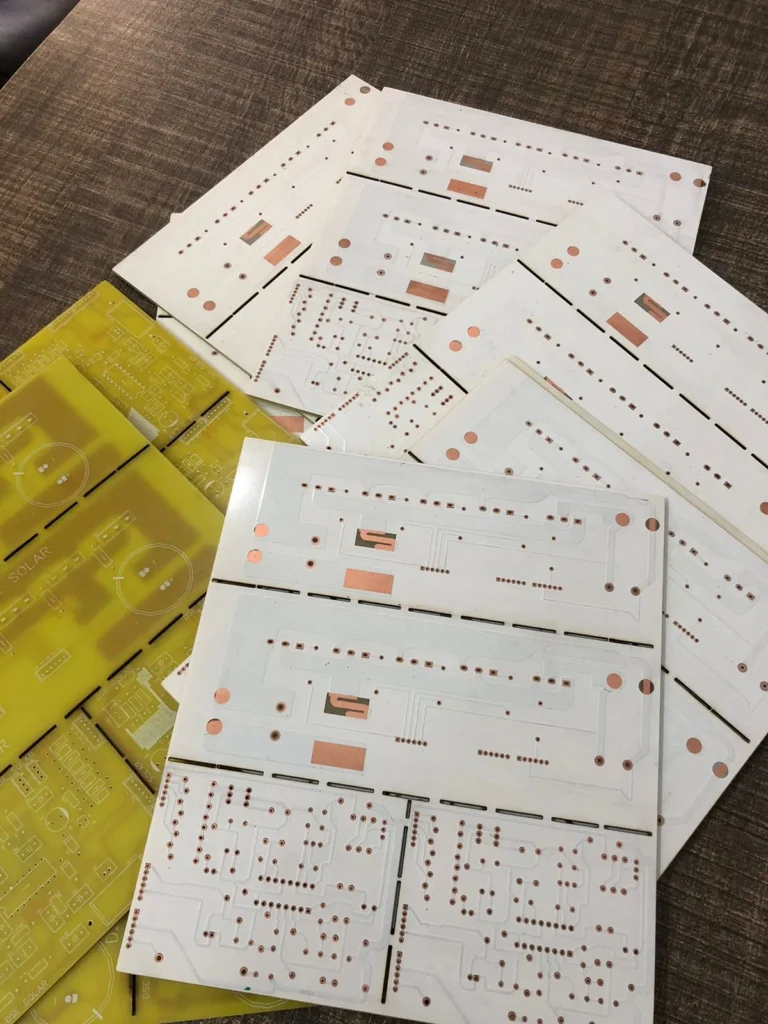
Why PCB Material Matters
The base material of a PCB (also called the substrate) acts as the foundation of your circuit. It determines:
How well the board handles heat
How stable it is in demanding environments
How fast electrical signals can travel
The overall strength and reliability
Choosing the wrong material can lead to overheating, signal loss, or complete product failure.
Common PCB Materials
Here are the materials most commonly used in the industry:
1. FR-4 (Fiberglass Epoxy)
Best for: General electronics, consumer products, industrial devices
Why choose it: Affordable, strong, reliable
FR-4 is the most widely used PCB material. It offers good strength, heat resistance, and electrical performance at a reasonable cost. For most everyday products, FR-4 is the ideal choice.
2. High-Frequency Materials (Rogers, Taconic, etc.)
Best for: RF circuits, antennas, 5G devices, communication systems
Why choose it: Low signal loss, excellent high-frequency performance
These materials are designed for circuits that need fast and clean signal transmission. They cost more than FR-4 but are necessary for high-performance electronics.
3. Flexible PCB Materials (Polyimide)
Best for: Wearables, foldable electronics, tight spaces
Why choose it: Can bend and flex without breaking
Polyimide offers great flexibility and high heat resistance, making it suitable for compact or moving devices where rigid boards won’t fit.
4. Metal-Core PCBs (Aluminum or Copper Base)
Best for: LED lighting, power electronics, automotive
Why choose it: Excellent heat dissipation
Metal-core PCBs help manage heat in high-power circuits, especially in LED lights or motor controllers where temperature control is critical.
Key Factors to Consider When Choosing PCB Material
When selecting the material, think about these factors:
1. Operating Temperature
If your board will face high heat, choose materials with better thermal stability, such as polyimide or metal-core laminates.
2. Signal Speed and Frequency
High-frequency circuits need materials with low dielectric loss.
For radio, 5G, and fast data applications, FR-4 may not be enough.
3. Mechanical Strength
If your board needs durability or will face vibrations, choose stronger materials like FR-4 or high-temperature laminates.
4. Flexibility Requirements
If your design bends or folds, a flexible polyimide base is the only practical choice.
5. Budget
FR-4 is the most cost-effective option. High-frequency and specialty materials deliver better performance but at a higher price.
Conclusion
The right PCB material depends on your project’s needs—heat levels, signal requirements, physical design, and budget. For most standard electronics, FR-4 works perfectly. For advanced or high-performance products, materials like Rogers, polyimide, or metal-core laminates may be the better choice.
By selecting the right material from the start, you ensure long-term reliability and smooth performance for your final product.